-page-001.jpg)

Parenting Styles: what works and what doesn't!
- Nishtha Shah

- Jul 28, 2020
- 5 min read
One of the most interesting things about being a parent is that you can use a wide variety of approaches to raise your child. Each individual, with their own thoughts and beliefs, employs different strategies to interact with their kid while they are growing up.
What are parenting styles?
Parenting style is a concept that showcases a set of parental attitudes towards a child which greatly influences the parent-child interactions and affects the child’s mental, emotional and physical growth. Each style varies in different ways like disciplining practices, love language, communication, nurture patterns and expectations.
How much does it influence your child?
Your parenting style can affect many aspects of your child -- from how much your child weighs, to how he/she feels about him/herself, to how they perceive their worth in this world.
It is very important to ensure that your style of parenting is supporting healthy growth and development. Your interactions with your child and how they are disciplined impacts relationships that they form during adulthood as well. Previous research showcases four common parenting styles, as explained below. Let's find out which one you are!
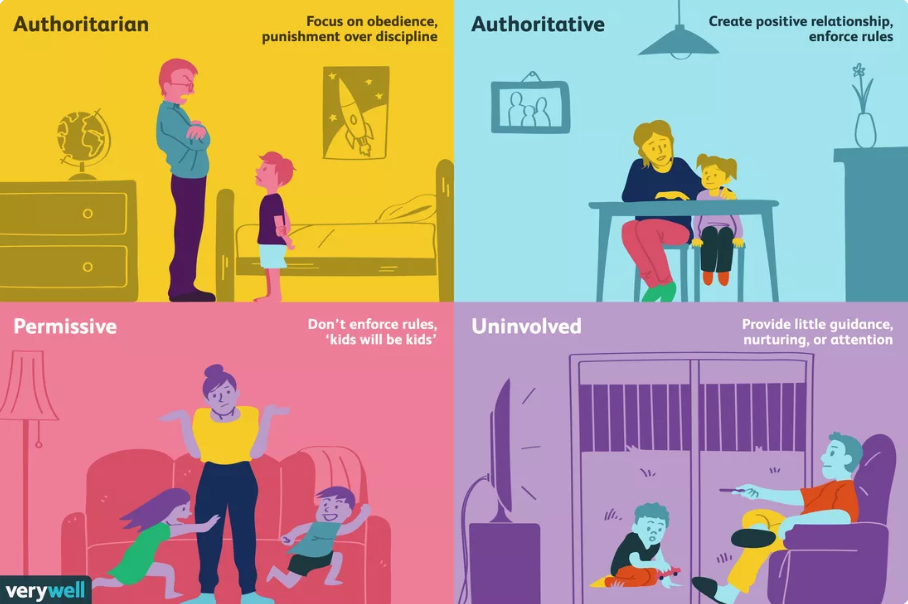
The Authoritarian Parent: High Control, Low Warmth
Do any of these sentences sound like you:
Do you believe kids should be just seen and not heard?
When it comes to disciplining and rules you believe it’s “my way or the highway”?
Do you think it is not necessary to take your child’s opinions into consideration because you know what’s best for them?
Is “Because I said so” is a common response when your child questions reasons behind a rule?
If any of these ring a bell to you, you are an authoritarian parent. Authoritarian parents are frequently thought of as disciplinarians. They are not interested in negotiations and believe that their kids should follow certain rules without any exception. When the rules aren’t followed, consequences like punishments are commonly enforced. They also have high expectations towards their children and showcase limited flexibility. They tend to show less warmth and responsiveness. Children of authoritarian parents grow up to be extremely obedient and greatly rely on authority. However, they are at high risk of developing self-esteem issues as their opinions are not valued. As their parents are strict, the children can also resort to lying in order to avoid punishment. They also tend to be timid and often lack spontaneity and social skills.
The Authoritative Parent: High Control, High Warmth
Do any of these sentences sound like you:
Do you put great effort in creating and maintaining a positive relationship with your child?
Do you value discipline but also explain reasons behind your rules?
Do you enforce rules and give consequences while also taking your child’s feelings into consideration?
If you believe in aforementioned statements, you are an authoritative parent. Authoritative parents have high expectations and clear rules but are also warm and responsive. They display a high level of control but are also willing to listen to the child and provide warmth and comfort. When the child does not meet certain expectations, the parents are more forgiving rather than punishing. Children of authoritative parents tend to grow up to be successful and happy. As parents display high control and high warmth, the child shows high-self esteem and enhanced social skills skills. He/she understands rules and is obedient but is also good at making his own decisions.
The Permissive Parent: Low Control, High Warmth
Do any of these sentences sound like you:
Do you set rules but rarely think about enforcing them?
Do you not believe in giving out consequences to your child's actions very often?
Do you think that your child will grow and learn best if you don’t interfere?
If you believe in these lines, you are a permissive parent. Permissive parents are extremely lenient. They tend to step in to help only when there is a serious issue. They are forgiving to the point where they showcase an attitude of “kids will be kids!”, have low expectations of their child and also indulge the child in materialistic things. They show high warmth and are very responsive but display less control and thus set very few or no rules. They always take a friendly approach with the child and avoid confrontation. When children grow up, they may display behavioral issues as they don’t value authority and rules. They also display impulsive behavior with poor self control and are often egocentric which causes relationship problems. Health problems are also common as permissive parents often don’t enforce good habits like ensuring that the child maintains personal hygiene (e.g. brushes teeth regularly).
The Uninvolved Parent: Low Control, Low Warmth
Do any of these sentences sound like you:
Do you not ask your child about his/her school or homework?
Are you not aware of who your child is friends with?
Do you think you don't spend enough time with your child?
Do you have almost no demands, are detached from your child and giving your child complete freedom?
If any of these sound familiar, you are an uninvolved parent. Uninvolved parents show a lack of control as well as warmth. It is highly likely that this lack of concern turns into complete neglect. There is a lack of communication and parents expect the child to raise themselves. Uninvolved parenting may not be intentional. A parent with mental or physical health issues might be restrained and may not be able to cater to the child’s emotional and physical needs consistently. These parents are often swamped by work, paying bills, household work and thus do not devote time to the child. Children with uninvolved parents often struggle with self-esteem issues and are likely to perform poorly in school. Lack of obedience and abidance to rules is seen as no authority is displayed by the parent while growing up. The child may also show lack of involvement in future relationships.
Translating parenting styles to a real life situation
For example, your adolescent kid wants to go out during the weekend with his/her friends where there is partying involved:
a] An authoritarian parent may say “No! If I ever see you going there without my permission, you will be in a lot of trouble!”.
b] An authoritative parent may say “I don’t want you to go alone right now, but we can go and check it out. If it looks safe, maybe you can go with your friends later!”
c] A permissive parent would say “Sure, you can go out whenever you want but be careful!”
d] An uninvolved parent may say “Whatever, go ahead!”
So, what kind of a parent should you be?
Many times, a parent may not fit into one single category but instead be a blend of multiple ones or keep changing their parenting style depending on the situation. Broadly, a lot of scientific research has shown that authoritative parenting is ideal and linked to best outcomes for children. As it involves high control and high warmth, it involves a delicate balance between discipline and affection. The parenting styles of different caretakers in a family can also combine to create a unique blend which may be an advantage for the child (e.g. mother is authoritative but father is permissive or the other way around). However, this can also confuse the child and so, it is essential that both parents communicate and combine their own parenting styles to create a cohesive environment for the child’s development.
Parenting is not easy, and growing up isn't easy either! Think of this as a journey that both you and your child are on, learning together and adapting to each other. You don't have to be the perfect parent on your first try (or even second), and your child shouldn't be burdened with being perfect as well.
Empathy, Trust and Respect!
Content contributed by Prachi Patel


Comments